Showing posts with label Mike Peth. Show all posts

Tuesday, August 30, 2016

From PhD Astronomer to Data Scientist

Like so many other recent graduates I have decided to trade in research in academia for research in the tech industry.

A few years ago, about half way into my PhD program, I wasn't sure what I wanted to do after I graduated. Would I enter the nomadic post-doc life? Am I actually qualified to do anything else? It was at this time I took a class simply called Data Analysis in Astronomy. This class really opened my eyes to a multitude of tools such as: principal component analysis, k-mean clustering, and many other statistical techniques. We had to do a final group project where we developed a facial recognition routine using PCA. This was a fun assignment and really got me thinking about a career where these tools are used in an applied way like this.

The other formative experience was listening to a talk by an astronomy professor/data scientist where he talked about some of the under appreciated results of statistical analysis. For example, he talked about how in Florida right before a hurricane, Targets/Wal-Marts were experiencing a huge spike in sales of a specific item, but it wasn't an obvious one. Not tissue paper, nor bread, nor eggs, nor milk, nor water nor whatever most people would immediately think to stock up on. Instead it was pop-tarts, which kids like, don't need to be heated to eat and are cheap. Here's a perfect example of a result that makes perfect sense when you reflect back on it but wouldn't be immediately apparent upon first thought.

(Funny this looks a lot like me! courtesy:
http://www.marketingdistillery.com/2014/08/30/data-science-skill-set-explained/)
After taking that class and listening to that speaker I realized I was more interested in the tools used to analyze data than the data itself. I discovered I wanted to potentially solve a ton more problems than just in astronomy. So I focused my thesis on machine learning (PCA, random forest, time series analysis) so I could more effectively market myself for a post-grad school life.

Applying to jobs and fellowship incubator opportunities are a little different than applying to a post-doc or graduate school. I decided to apply to the Insight Data Science and Data Incubator fellowship programs, which seek to provide training to academics so that they can transfer their skill sets to work in tech. Additionally, the Data Science for the Social Good fellowship looks like a great place to go if you're interesting in working for non-profits or city governments.

These programs offer different resources to accomplish those goals so it would be helpful to ask recent graduates about how the liked the experience. Insight's application was easier since all it required was a short 30-min chat with them to explain a project (thesis or other) that uses data. It's important to have something you can show visually. Data Incubator's application was much more intense. They require that you solve 2 difficult data problems, plus you are to propose the project you will work on during the fellowship. I didn't quite realize this project had to be near the final stages even before applying, so its best to come up with something well before the application due date. All told, I was offered a spot in the Insight Health data science fellowship but in Boston. I was more interested in staying in the Baltimore/DC region so I decided to continue to look for jobs in the area.

After a short search on Glassdoor, LinkedIn, and other job websites I found my current company, SocialCode. They focus on analyzing ads and ad interactions on social media (e.g. Facebook, Twitter, Instagram).

I applied to a few other places but the interview process was pretty similar for every company. Each began with a very short (~10 min) phone screen just to make sure I was who I said I was. Then a short (~30 min) chat with a current data scientist about my thesis work and they'd ask me some follow-up questions about the data analysis. Sometime in the process, the company would send a short data project that I had 3-7 days to complete. It was usually an open ended question to see how I would analyze data I'd never seen before. This project was then followed by a longer (~45-60 min) chat about the results of the project. Now if they liked what they'd seen and heard from me I'd be invited to an in person interview.  At these I would meet with a few current employees and they would grill me on my research, abstract data analysis questions, specific computer science questions among other topics. Honestly, the oral examination of abstract data analysis was much more difficult than defending my thesis!

I'm excited about what the future of data science will bring and how I can contribute, but I'd be lying if I didn't say I was going to miss astronomy. All the wonderful people I've met and interesting projects and teams I've worked on have been a great source of happiness. The academic route was just not for me. Everyone should follow their path as they see it, sometimes that means academia but sometimes not. Don't let anyone else's expectations for you determine your trajectory.

Tuesday, September 10, 2013

Drinking Bourbon, Talking Astronomy: the CANDELS Lexington Meeting

CANDELS team.  Photo courtesy: D. Kocevski

This year was my first ever CANDELS team meeting, and I didn't know quite what to expect. I knew there would plenty of discussion about galaxies, but after that I was unsure.  

I was nervous to give a talk to my largest audience yet. I was giving a presentation on my research about the structure and shape of galaxies with an active galactic nucleus (for more information on "AGN" check out this post) when these galaxies live either really close to other galaxies or far away from other galaxies. I eventually settled into a nice fluid delivery pretty quickly and realized quickly that 20 minutes really isn't that long.


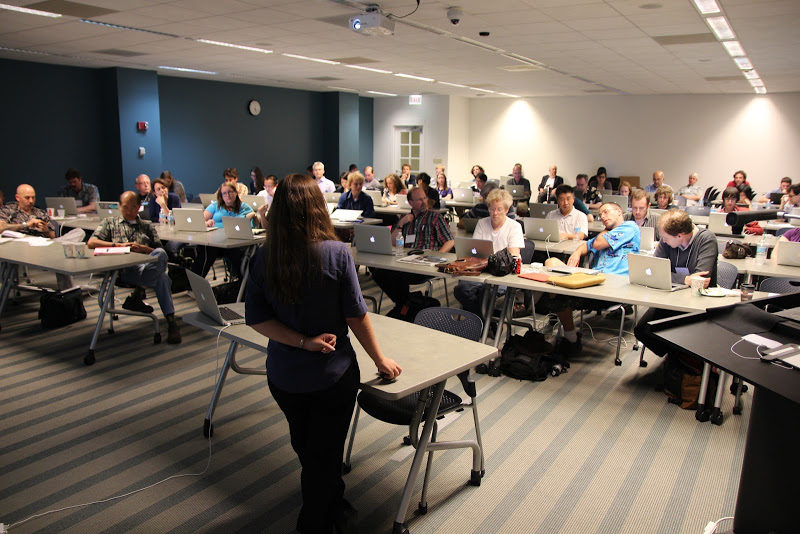
Astronomers busy listening and working.
Photo courtesy: D. Kocevski
In addition to my talk there were many, many others. On subjects ranging from supernovae to large scale computer simulations of the formation and evolution of galaxies. Some of the most interesting presentations dealt with something called "candelizing" images. This process takes simulated galaxies and blurs them to a point where they resemble real galaxies that would be observed in CANDELS images (hence candelizing). When a galaxy simulation is performed, theoretically all knowledge about it is known.  

These "candelized" images can help with the visual classifications of galaxies, both by professional astronomers (in CANDELS) and amateur astronomers (through Galaxy Zoo). We can classify the simulated galaxies based on what they look like after "candelization" and then compare that to how they look in perfect resolution. This way we can use typical observational techniques when analyzing these galaxies, except that now we have the "correct answer" for all the physical attributes of the galaxy.

I singled out just one specific discussion but there were plenty more interesting talks.  After listening to all the talks I certainly learned a lot.  

Throughout the conference we splintered off into break-out sessions where experts in a very specific subfield of astronomy (such as AGN, spectrometry, galaxy clustering, data products, etc.) discussed the major problems and upcoming team papers. (During the AGN session it was fun to see my paper advertised as forthcoming very soon!)  There was also a small group discussing education and public outreach.  I learned we have an iPad app displaying the universe from very large scales down to the size of the Milky Way. The app both looks really cool visually and full of interesting facts. Be on the lookout in the app store for it in the near future.

Another grad student asked why isn't all research like the conference. Where we are constantly in contact with all of our collaborators. While I think it would be awesome for a day or two, I think everyone needs personal time to work on all their pet projects best done alone.

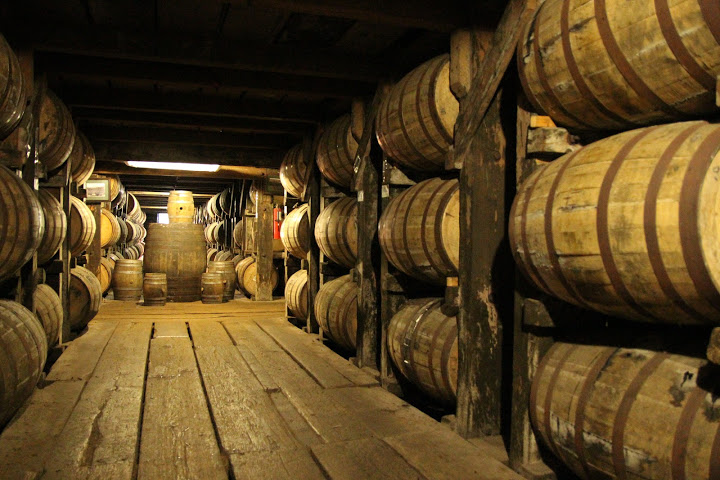
Basement cellar bourbon barrels, some aging over 20 years.
Photo courtesy: D. Kocevski
The (non-astronomy) highlight of the conference was definitely the bourbon distillery tour.  We visited Buffalo Trace's distillery in Frankfort, KY and got to see where "the magic happens".  We saw hundreds of barrels. (some of which have been aging longer than me!  I was afraid to ask how much those bottles of bourbon ran.)

Bottling by hand.  Photo courtesy: D. Kocevski
The tour guide also showed us the bottling plant, which is all done by hand. I asked one of the workers how many bottles a day they can fill and package and he said nearly 2000. If you're a fan of bourbon (or just seeing how things are made) I would highly recommend visiting the distillery.

After a week of astronomy my brain was full.  I don't think I could remember one more thing.  I had a great time and look forward to the next time we can all get together and talk about astronomy for a week straight.

Tuesday, January 22, 2013

AAS for a Grad Student

Hi, my name is Michael Peth and I am currently a graduate student of Astrophysics at Johns Hopkins University.  I'm working with Dr. Jennifer Lotz on the topic of Galaxy evolution and morphology in clusters as a member of the CANDELS team.  Which is basically a fancy way of saying I look at galaxies that are very close to each other (in a cluster) and from the shape, size and color I can determine a lot about their characteristics.  I am mostly looking for galaxies that have a supermassive black hole currently eating gas and stars, which causes it to shine brightly.  These types of galaxies are known as Active Galactic Nuclei (or AGNs).  A necessary aspect of research science is to present your work to the community as a whole. The American Astronomical Society (AAS) conference that was just held this month in Long Beach, California is a great  forum to let everyone know what your research has accomplished.  So I set out to attend this meeting and present my own research to an eager community.

Long Beach Harbor at Night looking out on the Queen Mary II Ship/Hotel
It's exciting to meet fellow astronomers outside the womb of academia (on the street, hotels, airport shuttles). It reminds me that I’m a part of something larger (which, really, is something that astronomers are constantly reminded of). For instance, after I arrived at LAX, I boarded a shuttle to Long Beach with 8 other people.  One of them happened to be a fellow astronomer. He said, "You expect to see fellow astronomers outside these conferences at a rate ~1/r^2".  I laughed because I got the joke.

Anyone who wishes to present their research at the AAS conference has the following options: 1) a Poster Presentation or 2) a 5-15 minute Research Talk. I decided that a poster made the most sense for me, since I had presented one last time I attended a AAS conference – in January 2010 – and knew what it entailed. The poster-making process is pretty straightforward. I quickly realized that the trick to crafting an effective poster is minimal text and plenty of graphs and diagrams – it may sound cliché, but a picture is worth a thousand words.

My Poster hanging in the conference hall
Before I tell you more about my experience, allow me to digress.  Three years ago, the AAS conference was in Washington, DC. At this time, I was an undergrad finishing my senior year at Penn State. I was also in the midst of applying to a slew of grad schools. I was hoping that, while I stood by my poster, I would have the opportunity to speak with some professors from the schools I was applying to. Even though I was stationed at my poster all day, only a few people asked me about my research. Only one of those people was a professor from a school I had applied to. Needless to say, I was a bit disappointed. However, when I look back on the experience, I really regret missing out on the morning and afternoon talks when I was guarding my poster. This time around, I knew that the best times to show off my research were from 9-10am (before talks begin) and from 4-6:30pm (after most talks are over).

When I tell non-astronomers (i.e., my family) about the poster session, they seem to think that I'm standing in a room with an audience, actively presenting my poster. However this is not the case.  Such an image is more akin to the 5 minute talks given. Poster sessions are different – we hang our work in the ballroom of the convention center and people intermittently walk by; they will occasionally ask questions if they are interested in your project. During the morning session, I was pretty much continually explaining my research to onlookers. The afternoon was somewhat less trafficked but I still was able to explain my research to multiple people. I was even able to meet one of my posters co-authors, who I had only previously interacted with via email. This part of the poster session is great for networking, in addition to seeing old friends and collaborators.

Long Beach Ferris Wheel outside the Convention Center
The poster session is not limited to single-entity astronomers and their research – it is also the domain of private companies, telescopes, publishers and other corporate entities. These groups have booths that detail their work, as well as offer a valuable opportunity to learn about potential employment outside of academia. But I would be remiss if I forgot to mention that these organizations offer plenty of swag. A highlight for many conferences-is the numerous free pens/stickers/posters/pins/laser pointers. One free product – the LED badge – even crossed over into wide usage for poster presenters. It’s basically a high-tech nametag, with an LED function that can be programmed to display any message you want. Many people programmed them to say things like, "Astronomy rules.”  It was an extremely nerdy (and therefore cool) utilization of the technology.

As I implied earlier, the research talks are the main attraction of the conference – when they are in session, most conference-goers are in attendance. I heard talks about galaxy evolution (which is my general research area), exoplanets, and even educational outreach. What many people don’t realize is that the Astronomy world is pretty disparate; people from different research areas seldom come together and share their work. For instance, I learned that, within 30 pc (or roughly 90 light years) there are potentially hundreds of Earth-like planets. This is a factoid that I wouldn’t discover within my own body of research, and it’s also something that reminds me how limitless, vast, and uncertain our field is.

One of the more social highlights of the week is the party that AAS always throws at a local nightclub. This year, the party took place at Sevilla, a Latin dance club just a few blocks from the convention center. It's always fun to see a bunch of awkward nerds cut loose. I always get the feeling that people view astronomers through the lens of The Big Bang Theory, and perceive us as socially incompetent nerds who take themselves too seriously and don’t know how to have a good time. If they had been privy to this party, they would see that they are only half-right: for the most part, we are socially awkward. But that never stops anyone from having a good time.

Soon enough, the conference came to a close. I felt like I learned a lot about Astronomy - especially subjects I don't primarily study. It invigorated my enthusiasm about the field in general and, although I had a great time, I felt excited to get back to Baltimore and continue on with my own research with this fresh perspective.