Showing posts with label Outreach. Show all posts

Tuesday, December 17, 2013

Project Astro Kick-off at Donaldson Elementary School

Like last year, I and many other astronomers around the US are participating in Project Astro. Project Astro partners a teacher with an astronomer. We introduced Project Astro in this previous blog post and told you about the workshop that is held at the beginning of each new school year at the National Optical Astronomy Observatory in Tucson, Arizona. In short: The goal is for the astronomer to help the teacher to bring astronomy and science closer to the children in the classroom. Various activities support this goal.

This year, I am partnered up with Donaldson Elementary School's 4th grade classes. Donaldson Elementary is a public school in the North West of Tucson, Arizona. Each of its 4th grade classes consists of about 30 children. Last week, I visited the 2 classes for the first time. When I entered the class room, the children looked at me with big, excited eyes. As a welcome present they had prepared a book for me with drawings of what they think a female astronomer/scientist looks like. It was really touching and their art work was great. Their female astronomers came in all shapes and sizes and forms and colours. I particularly liked the one that put me on the moon!

What does a female scientist/astronomer look like? Here are a few example images of what the children thought before meeting me. Image credit: Janine Pforr, drawings from Donaldson Elementary 4th grade pupils.

We started off with just a general question and answer session, so the children could get to know me a little better and ask anything they wanted to know. One hand after another shot up. And boy, did they ask tough questions! For example: "What's left after a Supernova?" or "How did the Universe start?" or "How long can a person live in space?" or "What is the biggest star?" (You can check for a list of the largest known stars here, they are nearly 2000 times larger than our Sun). It was great and I was really impressed with their sheer endless curiosity.

Phases of the moon. Try to find the right order!
One solution is below, but no early peeking!!
Image Credit: "The Universe at your Fingertips"
and the Astronomical Society of the Pacific.
After that, we started our first activity, the phases of the moon. At the outset I had every child draw how they see the moon. Some drew full moons, some half-moons, some crescent moons. All had craters on them. Some added aliens and the American flag and the moon lander module. We discussed how everyone's drawing looked different and then I distributed little cards that have different moon phases on them, which the kids had to order. Naturally, most of them ordered the pictures from smallest crescent moon to full moon, thus creating half a cycle. The pictures however showed a full cycle. By drawing their attention to the details in the pictures, i.e. craters and mares, I had them rethink their choice and order. With a little help all of them managed to get the order properly and we talked about how often the moon cycles through its phases in a year and how long one cycle roughly is. Next time, I think we'll talk about what causes the moon phases and the seasons.

That day, the kids were very sad to see me leave, but I am sure we will have a great next visit.

With all the curiosity and interest of the children during my first visit, I have to say that I had one special highlight of the day. During recess, one of the little girls came up to me and asked if I was a scientist, which I confirmed. And then she said she wanted to become a scientist, too, when she was grown up. I thought that was very sweet and also exactly what many of us want to achieve with outreach events like this. We want to interest more children in astronomy in particular and science in general and encourage young girls especially that math and engineering and science is for them, too. 

One possible solution for the right order of the moon phases. Image Credit: "The Universe at your Fingertips" and the Astronomical Society of the Pacific.

Thursday, October 10, 2013

Our Blog Featured on Learning Space

Last week, Janine Pforr and I participated in a live Google Hangout on Learning Space,with Nicole Gugliucci and Georgia Bracey from CosmoQuest. We discussed the CANDELS survey, public outreach, and this blog. Take a look below!


Tuesday, August 13, 2013

Reaching out for CANDELS outreach

On May 28th 2013, our blog turned 1! So Jeyhan and I decided, it's time to share what we have done outreach-wise with other people outside the CANDELS team that are interested in Education and Public Outreach (E/PO). At the same time we wanted to see what other people are doing in terms of outreach. And what better opportunity than the annual meeting of the Astronomical Society of the Pacific (ASP). Off we went with our poster under our arms to San Jose, where this year's meeting took place from July 20th to July 24th.

The annual meeting of the ASP is structured very similar to the annual meetings of the American Astronomical Society (AAS, we reported on those here and here). There are plenary sessions which are held in bigger auditoriums, so everyone at the meeting can attend, smaller concurrent sessions that anyone attending chooses according to their own interests and poster sessions during which everyone can come and read your poster and chat with you about it. This year's ASP meeting was special in that it combined two very important topics in one meeting. One half of the conference was called "Cosmos in the Classroom" and all sessions belonging to this category focused more on how to best teach Astronomy in school and college classrooms. The other half was called "Ensuring STEM (Science Technology Engineering Math) Literacy" which was more focused towards general outreach activities, such as our blog. Naturally, the background of the meeting attendants was quite widely spread, there were teachers for every grade, scientists like us that do outreach in their spare time and those that are hired to do outreach professionally. 

Jeyhan in front of our poster. Image credit: J. Pforr
However, the ASP meeting is much smaller in numbers compared to the AAS meetings. Fortunately, that meant that our poster was up all three meeting days and we had ample opportunity to talk and connect to other like-minded people, gather feedback and collect new ideas. 

On our poster we shared what CANDELS is and what our blog is about, what different types of posts we have, etc. We also gave an overview of statistics on the blog, how many people stop by the blog on a daily basis (on average of course), how many people have viewed it since we started and which parts of the world we have reached so far.

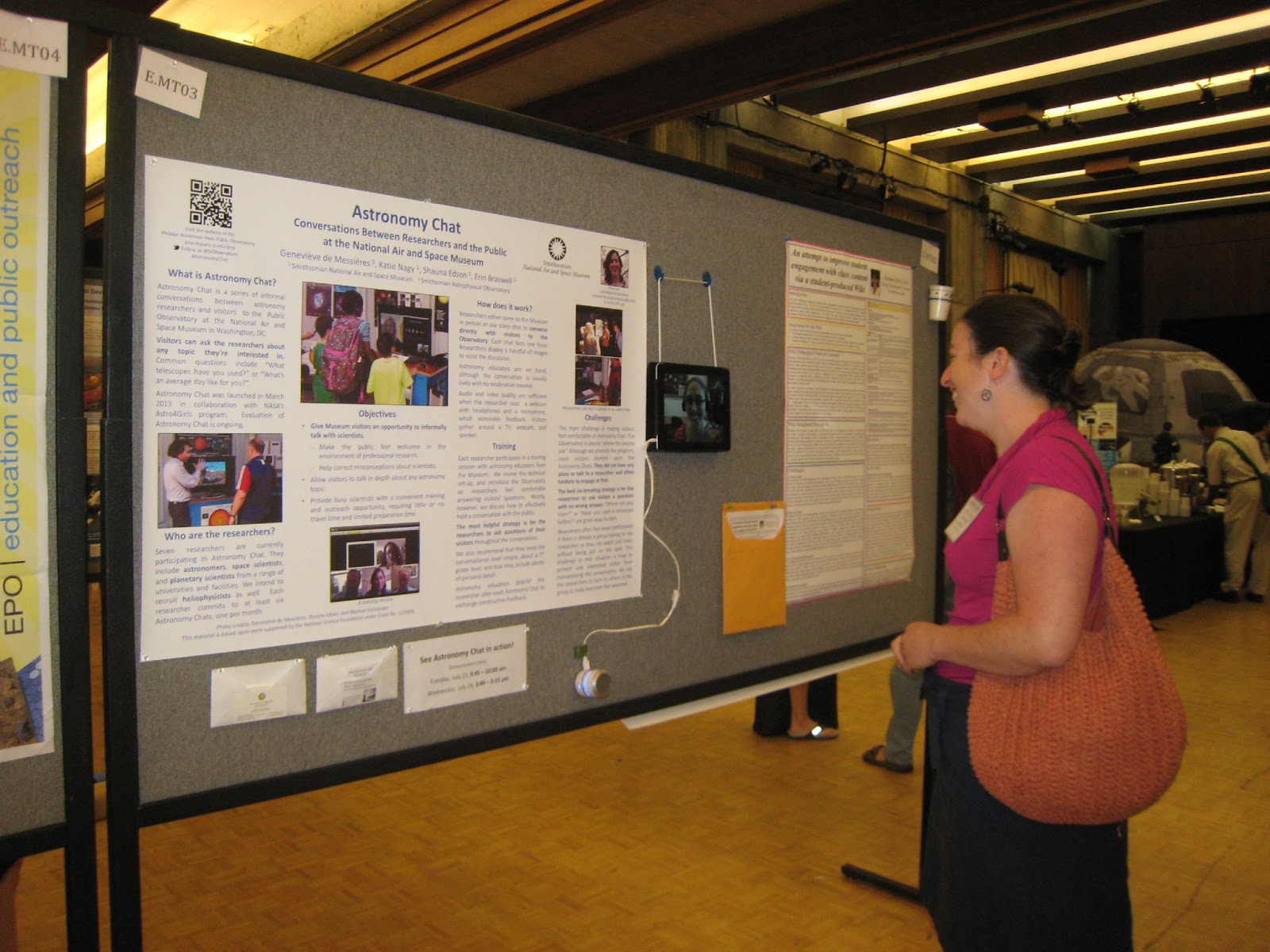
"Chat with an Astronomer" Poster at the ASP meeting. You can
see the little iPad next to the poster which connected to the
astronomer on the other side and provided an opportunity to
try it all out. Image credit: J. Pforr
We heard a lot about the outreach other people are doing and stumbled across fun things. One of them was the WorldWide Telescope. Interested parties could put on one of those virtual goggles, were given a game controller, and could fly through the Universe in proper SciFi fashion. 

Another cool thing was the "chat with an astronomer" poster by Genevieve de Messieres from the Smithsonian Institution and her colleagues. They explained how they are using their system at the Public Observatory at the Smithsonian National Air and Space Museum in Washington, DC.  During some of the poster sessions, there was an iPad and a microphone attached to the poster board next to the poster where you could actually talk to and see an astronomer on the other side of the country. I tried it, it worked really well!

The poster right next to us presented a new version of the game MyStar in which you build your own solar systems in our galaxy and can learn a lot about planet formation and extrasolar planetary systems. If you haven't tried it, I suggest you give it a go!

In another corner of the poster exhibition hall, there was a huge inflatable planetarium waiting to be tried out. You already heard more about a similar one in this blog post.

Right next to it, there was a huge blue screen. This was our chance to get recorded while "being in space". So if you stood in front of it, you were interviewed very briefly and filmed. The blue screen was then digitally replaced by an extragalactic space background so it would seem like you're actually in space. If I ever get sent the video of this, I will add it here.

Camilla Corona SDO visiting our poster! Image credit: J. Pforr
But besides all the fun and gadgety stuff to try out we also learned what challenges teachers and educators face when teaching astronomy and sharing their science with the world. We learned how to best put an Astro 101 course together and how to evaluate the success of an outreach project or college course. In interactive group work sessions we shared and found other creative ways to reach more astronomy interested people and how to improve communication.

All in all it was quite an information-packed meeting with lots of interaction. On the last day, we even had a special guest visiting our poster. It was Camilla Corona SDO! For those of you who have not heard about Camilla, have a look here, she's the former mascot of the Solar Dynamics Observatory now turned STEM ambassador, and she was very interested in our poster.  

Friday, August 9, 2013

The Inflativerse - Bringing the Stars to ... Wherever We Want

Today's blog post is somewhat different to what you normally read on this blog. Although this project is not what we (as CANDELS astronomers) technically do for a living, projects like this are an increasingly important part of our job description: Outreach. It's not 'science' as such, but it is an important part of science communication and scientific education. And just as importantly: It is FUN and we hope to encourage people to start a scientific career. Today, I want to introduce to you 'The Inflativerse', a mobile planetarium project that I started at The University of Nottingham while I was still there and which is now being run by a team of astronomy PhD students and undergrad volunteers. But let me start from the beginning.

In spring 2011, we, the Astronomy Group at The University of Nottingham, UK, were asked to participate in a 'Big Bang Science Fair' in Nottingham. This was part of a bigger series of events all through the country. The main part of these fairs is formed by school pupils who present scientific projects. At the same time, the organizers invited scientific departments and organizations to present themselves. 

Astronomy is an area of science where this is usually very easy to do. All we usually need to do is show pretty pictures and give public talks which all of us have up their sleeves and prepared. However, at this particular event, we were explicitly told to NOT present talks, but to present something else. This immediately becomes difficult (Think of it, what would YOU do? If you didn't have any money to do it?). In the end we managed to come up with some nice ideas, offered an 'ask the astronomer' booth (something that I guess every astronomy department has offered many times) and brought different light bulbs and spectrometers for people to look at them. The different light bulbs use different molecules/atoms as lighting material, so their spectra look very different. We were then able to explain how astronomers can use information like this to find out physical properties of astronomical objects. This, however, is a different topic and has been discussed in this blog in a previous post.

More importantly for this blog post, Nina Hatch and myself had this 'crazy idea' over tea when trying to figure out what we would bring to the Big Bang Science Fair: "Wouldn't it be great if we had a small planetarium that we could take to events like this?" We knew some universities had these and they formed the backbone of their respective outreach programs. In fact, Nina had already worked with one of them when she was a student at Edinburgh. What we did not know was where to get one, what they cost, what different versions there are. So, we went home, had a rather extensive search online and found out that not only are there several commercial suppliers of these planetaria, but there was actually quite a variety of different types. There are digital and non-digital, different sizes from 3 meters to about 10 meters across, different domes (some where you have to crawl in, some with a zip as an entrance, some self-standing, some only inflated by themselves -- e.g. deflating when the door is open -- and some that looked like bouncy castles.

For money reasons, we decided to go for a non-digital one. They are usually simply a small light source (in our case a LED) over which you put a filter (basically a big black box with holes, although the brighter stars might have lenses, too). They are about half the price as digital ones, but obviously have the disadvantage that one has to buy particular filters to project particular things, so we couldn't just plug in a laptop and show whatever we wanted. On the other hand, it meant that our 'projection' was not pixelated. I have seen digital planetaria now that use 'old-ish & cheap' projectors and they look terrible, a 'pixel' on the dome is up to 1cm across, hardly what we call 'good resolution'. Today, I am quite happy with our decision. Only recently do projectors have high enough resolution that one could have another go. Only these days have projectors got good enough resolution that one could have another go. More about that at the end of this post.

A Typical Starlab Planetarium.
Image Credit: The Inflativerse Team
We decided to buy a 'starlab.com' planetarium with 10 filters, which came to ~£17000, including some additional equipment like boxes for transport, a small netbook for additional activities, etc.. Plus running costs.

As you can tell, this is rather expensive for the odd event/fair to visit, but at this point we had gotten so excited about the project that we wanted to take it much further than initially thought of. From our web search we knew that several semi-commmercial suppliers in the East Midlands offered planetaria experiences to schools (find out about planetaria in your UK region here), but they all charged the schools £400-£500 for a day, which many schools can't or don't want to spend because they need it for (admittedly) more important issues. We decided to take the planetarium to schools for free in order to offer this experience to many school-kids, tying in with the school curriculum. Specifically, we wanted to target 'Widening Participation' Schools. 'Widening Participation' schemes in the UK are trying to get people from under-privileged areas/schools into university. Most universities have WP programs and contacts at schools, so we would not even have to start from scratch, the contacts were already in place.

So our next task was to find the money. We asked Michael Merrifield, the head of our department, for advice and he suggested a few people to talk to  We contacted two or three people and got a reply from all of them pretty much immediately, some even pointing us onward to the same persons. It turns out (and here's a god tip for departments) that it was (by then) the end of June and the end of the financial year in the UK (or at least Nottingham) is July 31st. That means that some budgets throughout the university had some money left that 'needed' spending and were happy to spend it on projects like this. 'All we needed to do' was write proper proposals for them, which we did straight away, including a pre-invoice and official cost estimate. We managed all this in time and in the end the Nottingham part of HEIF (Higher Education and Innovation Fund) agreed to cover £15000 of the equipment and the School of Physics agreed to cover the rest of the equipment as well as the running costs of the project (e.g. car hires for transport). The only requirement: The equipment had to be delivered (not ordered) by the end of the financial year, which was only about two weeks away at that moment. With lots of help from the UK contact of 'starlab', our finance department, which managed to pay everything as fast as they could, and the starlab shipping team, we indeed made this deadline. (As an additional remark: After we had placed the order, a different grant, the 'University Annual Fund' also agreed to fund the entire project. This Fund is run using alumni donations to the university for projects like this. That means that in the end we would have had enough money to buy a digital planetarium. Now, however, the Annual Fund only had to cover the rest of the equipment, which is why it should be mentioned here, too. And as I said, we are not unhappy with our decision at the time to order a non-digital planetarium.)

Inflating the planetarium for the first time.
Image Credit: The Inflativerse Team
So, by the 1st of August, we had a planetarium at the University, put it up in one of our teaching rooms and simply had a go at it. We were a group of about 8 people, playing with it, trying all the different filters and, admittedly, lying in the dome, gazing at the night sky. I remember I was amazed by the quality of the projection and I think for most of us it was hard to force ourselves to pack it up and go back to work after about 4 hours.

The first two things we needed was another person to help out with organizing the project and a name for the project. Nina was about to start maternity leave and I didn't want to handle it all by myself, firstly because we thought that it was going to be a lot of work and secondly because I was only on a 3 year contract and we wanted some 'consistency' in the project which is easier to achieve with more people where not everyone leaves at the same time. Lucky for us one of our students, Evelyn Johnston, seemed very eager on our test run and after what we thought would require some convincing (but turned out to be simply asking) she agreed to help. We also got Meghan Gray involved as a staff contact to oversee the project. Throughout the 2 years this has been running now, she has given use very good advice at times and in case she reads this, a 'Thank You' is in order. 

Name-wise, we had several ideas, here's a selection: Nottingham Spaceport, Astronomy road show, Star Dome, Stars on Tour, Nottingham Mobile Planetarium, 2π in the Sky, Universe in a Tent, Universe in a Nottshell. You can tell that astronomers are rather bad at making good names. Many of these names were already taken, some even by companies (e.g. suppliers of inflatable domes), which we wanted to avoid. Jamie Ownsworth, one of our PhD students and also a CANDELS member, at some point threw 'The Inflativerse' into the ring (from 'inflating' and 'universe'). Some people didn't like it in the beginning, but over the next days, this became the clear favourite, so we decided to name it 'The Inflativerse' in the end.

Evelyn giving a show (with some spooky light
for the photo, usually it's dark in the dome).

Image Credit: University of Nottingham
Through contacts at our university (mainly Lisa Owen, 'Thank You' to you, too!), we started to contact schools and immediately found that this project was rather popular. As already planned, we recruited a larger team of volunteers, in this first year from our own department, ending up with about 12 people (including Several CANDELS members, Alice Mortlock, Jamie Ownsworth, Will Hartley, myself) for the 12 school visits that we had proposed for the first year of the project. So over all, pretty small time constraints were needed from each volunteer, about 3 school visits/year. It became clear that we would be rather man- (and woman-) power limited -- we could have visited many more schools even in this first year. Without even pushing. We never really advertised the planetarium anywhere other than through direct contact and word-of-mouth from teacher to teacher. Yet the requests keep coming in and many people find us through our website.

In order to be able to start school visits in September/October, we immediately started to develop some shows that we could present to kids of different ages. We had decided to target years 4 and 9, but soon found out that schools teach astronomy in different years, so I think by now, we have visited kids of all ages, including a nursery. I think our first attempts of shows felt rather clunky, but with experience and confidence they got better and better in the end. On our first school visit to the Nottingham University Samworth Academy -- a school connected to the University of Nottingham and the only non-WP school that we visit -- two film makers made videos about us, one from the school and one sent by Brady Haran (a film maker who runs the youtube channel sixtysymbols). You can find both videos here and here.

[This is the point where I have to put something straight: When the above videos came out, MANY blogs -- just google "Inflativerse" -- posted about us. In a process where people simply copy information from other blogs, most of them stated that we had actually developed the dome and projector. We have NOT. It's a bought system, we only turned it into a cool event for schools, but even there we are by far not the first ones. St. Andrews and Edinburgh had their projects running for years, and I am sure there are even older ones than that. While we are not the oldest, I think we do have the coolest name ;-) ]

This is the Greek mythology filter. Unfortunately it is very
hard to take a picture of the normal sky field, so I can't show
one here. Image Credit: The Inflativerse Team
Over the months, standard visits developed. We would take the younger kids on a trip through the night sky and the Greek myths that are connected to the constellations (a great book to be recommended in this context is 'The Mythology of the Night Sky'), while carefully avoiding the not so child-friendly bits (the stories are over all rather gory and include a lot of stuff not quite suitable for 8 year old kids). For the older kids, we include some of the same stories, but on top of that, we include much more about physical processes. This is a short list of topics we can (and regularly did) cover: The sky at night, Constellations, how to tell a star from a planet, Ancient Greek mythology, Light pollution, Constellations, Navigation by the stars, Phases of the moon, Our Galaxy - the Milky Way, "How do I become a scientist?", Changing seasons, Temperatures of stars, star clusters, nebulae, stellar nurseries and many more. 

Our ocean current filter. Image Credit: The Inflativerse Team
But we have filters for more, e.g. ocean currents and plate tectonics, and can implement many other topics into the shows. One of my personal favourites is 'Harry Potter on the night sky' and 'Tolkiens Sky', featuring many names from Harry Potter books that are taken from constellations and stars (a surprising amount!) or the constellations and stories explained in the Lord of the Rings and other Tolkien stories (Probably something I should pick up again and work out in a bit more detail, given that I moved to Oxford and Tolkiens home-pub is 100-200 meters from my desk).

Throughout the entire process, I personally found it very positive that, while we did write down some of the shows, we never forced people to stick to exact scripts. We wanted every single presenter to be comfortable in his show and make up his own script. While this meant that we had a slightly longer learning process, it made sure that we came across as enthusiastic rather than a robot that just repeats what he's told.

In addition to our planetarium shows, we have developed some other activities that can be run either in a classroom or outside the building. One of our favourites here is a scaled version of the solar system. We use a football (a proper, 'soccer' football) as the sun and then, while talking the kids through each planet from the inside out (we show pictures on an iPad or small laptop), we walk them through the scale model of the solar system. At this scale, the Earth is a bead 2mm across at a distance of 23.5 meters, which gives the kids a rather good impression of how empty space actually is, even in a 'crowded place' like the solar system. We also own a real piece of space junk (a piece of an asteroid found in Argentina and sold on ebay) which we usually pass around in that context.

Last year, we re-organized the team, now recruiting undergrad students as well, and the project has been very successful over all. Over the last 2 years, we have visited 24 schools and several public events, amongst them 'Nottingham Light Night', 'BBC stargazing live' 2012 & 2013, University Mayfest 2012 & 2013,  with a total number of ~4000 visitors into the planetarium. We also had several Brownie groups visit the university for a planetarium visit and the dome was used for the 'brain awareness week' (They called it InflatiBrain) by a different department. They didn't project the stars, they projected the structure of the brain. But our achievements are not only of public type, we (Jamie Ownsworth) have also given a talk at the IAU in Beijing (one of the largest conferences in astronomy), so I hope we are leaving some imprint on professional astronomers, too. Maybe someone will follow our example and build up their own 'Inflativerse'. It has been a lot of fun for all of us (while at times it was rather a lot of work) and I think both the department and the community benefit massively from such a project.

Additionally, I have to mention that we personally all benefited from it, too, and I have to thank all the volunteers in this project for their great efforts and for helping us run the Inflativerse over the last 2 years. All our volunteers have done great work and I am sure their school visits and the experience gained will benefit them in their future and if it's only from being more confident to talk in front of bigger crowds. Evelyn was nominated for the 'IoP Very Early Career Physics Communicator Award' for her work and I myself have managed to secure a 3 months outreach fellowship from the university in the first year in order to start up the project and set it up it as a sustainable outreach program. Recently, all 3 of us were also told that we will receive the Vice-Chancellors Achievement Award from the University of Nottingham for the project, something, I have to say, that I feel rather proud about. Without the help from all our volunteers, I am sure non of this would have happened. More generally, outreach projects like this look very good on a CV and, as they become more and more important in our jobs, are a valuable skill when applying for jobs. So to all the astronomers and all other scientists who read this: you can see, that this kind of outreach work can and will be rewarded on some level or the other. While people always complain that outreach is 'not their job' and 'a waste of (research) time', it seems to help to keep us in a job, so everyone out there, please keep up the good work.

As I mentioned above, I have meanwhile moved away from Nottingham, so 'The Inflativerse' is not in my hands anymore, but I keep strong personal links and sometimes still wear my Inflativerse T-Shirt with pride. Oxford, where I am now, co-owns one of these domes, too, but they do not take it to schools as we did in Nottingham. Occasionally, we get classes visiting here and we use it for open days, but on a much lower level than in Nottingham. However, techniques have progressed and affordable projectors are now good enough to be used in a planetarium context. We took a look into upgrading our starlab system (an older version of the one used by The Inflativerse) to a digital projector and have actually already ordered all the parts. For ~£2000, we bought a HD projector and some optics (including a fish-eye lens) and we will soon build a digital system ourselves instead of buying the $40000 commercial versions. We have to hope a bit that this works in the end, but we are optimistic, given that we have people in the workshops that have built MUCH more complicated optical system than that, e.g. scientific instruments for telescopes. 

The ultimate goal here (besides using the more flexible system in-house) is to pre-record shows and train teachers on using the dome so that they can borrow the planetarium and run school events themselves. We have all the parts here now and will be starting on this pretty soon. When we have a working system, we will also try to distribute the plans and links to the community, maybe someone else (maybe even Nottingham) is willing to spend money on this 'low-budget' digital system and share their pre-recorded shows, hopefully building up a great database for the future. But this is my next project and should be discussed once it's running in a separate blog post.

Friday, July 26, 2013

Astro and the City

Many times, when I tell somebody that I'm an astrophysicist, they imagine that my job involves sleepless nights looking at the stars, worrying about inclement weather, city lights, an atmosphere eager to capture my beloved photons, and the occasional cosmic debris that could get in my way. How cool would that be? Sometimes, I wish I could I bask in that glory and I am tempted not to reveal that I belong to the much less glamorous subset of the "theorists" - my concerns tend to be about codes that don't run, take too long to run, or whose final outcome doesn't make any sense. Somehow taken aback by this news, my interlocutors (before checking that I don't know much about the multiverse either, and turning around to speak to someone more interesting) sometimes offer as a consolation: Well, at least you can do your job from anywhere. And it's true. In particular, I can do it from the best city in the world and not care about its crazy light pollution, or proclivity to snowy, rainy, or otherwise very humid days. Astronomy in NYC is very much alive - because even if you can't look up, you will look around, and that's what science is about. 

When I first started my job as an assistant professor at CityTech, a four-year college that is part of CUNY, I was thrilled, in order to: 1. Have a job; 2. Have a permanent job; 3. Have a permanent job in a place I like a lot. There were challenges; there still are. Others on this blog have described the time management problems of your first year in a tenure-track position better than I could do it myself, so I won't try. But what I found to be very unique about this place was an unanticipated support network of colleagues, and some incredible opportunities to connect with the public. 

CUNY, the City University of New York, is one of the largest public universities in the country; more than a quarter million people attend its 23 colleges. Still, none of these colleges has an Astronomy department; each of the 10 full time Astronomy faculty belongs to Physics, and despite that being my first love, I have now moved on with my life and want to do the fun stuff. So what we do is to gather in the Astrophysics Department at the Museum of Natural History, a place that is incredibly inspiring with its views of the Hayden Planetarium. Office space is tight and one could expect that some sort of seniority may determine whether or not you deserve a cube on the sixth floor. Instead, my colleagues made me feel welcome from day one, from escorting me to the common lunches when I was still too shy to go alone, to encouraging me to come more often and conquer my seat that way. They had successfully applied for a grant to support undergraduate research in the NYC area; I am now benefiting from it by supervising a great student that they had recruited. In no department of Astronomy I found such a knit-tight sense of community, and I think it comes from being somewhat outsiders ourselves. So, CUNYastro, thanks! I want people to know who you are. 

Image credit: Brooklyn Superhero
So I'm all set for the work part. What about reaching out to the public? Well, doing that in NYC is the most fun I've had in years. Last year I was asked to set up an activity for 6-8 grade kids at the New York Hall of Science. Sounds just normal so far… but the context was a little different: the singer Bjork produced an album called "Biophilia" and inspired by her love for science, and was promoting the album by organizing week long camps for children where they would learn about music, biology, physics, and Astronomy. The song I was illustrating was "Dark Matter" - it might be tricky to relate this topic to children, but it gets easier if, five blocks from where you live, there is a shop called "Brooklyn Superhero" where Dark Matter is sold by the gallon (and of course, they are not just a store, they organize all sorts of educational activities). I actually saw one of them at the last AAS, so they are becoming famous! 

Recently, an email was sent around to the Museum internal mailing list about an initiative called "The Intergalactic Travel Bureau", and I thought it would be fun to participate. We set up a travel agency in a temporary space close to Penn station, and proposed to our clientele destinations like Pluto (great for skiing and debates!), Jupiter (great hurricane watching and moon-hopping), Titan (swimming in frosty methane lakes), or Venus (gotta lose those stubborn 10 pounds before the holidays?). Since most of our clients couldn't afford the hefty fees or long leaves of absence from work associated with interplanetary travel, we would also give them the option of just sending postcards from these exotic destinations to friends and families.

Mark Rosin, Jana Grcevich, me, and Olivia Koski.
Image credit: Olivia Koski

It was a great way to connect to the public, especially because most of the people who came in weren't expecting us to be there, and/or had no previous interest in Astronomy - yet, everyone was a good sport and kept a straight face while we were describing the dangers of sailing the solar winds or diving into Europa's oceans. On my side, while happily riding back to Brooklyn on my scooter and enjoying a gorgeous "Manhattanhenge" looking west on 34th street, I found myself thinking of what very special mix of stories and people made this initiative possible. The original project was developed in the UK by an organization called Guerilla Science, whose US president, Mark Rosin, will be joining the faculty at Pratt in the Fall. The main organizer, Olivia Koski, is a former engineer with a passion for Physics and Astronomy and a graduate degree in Journalism. Someone she knew from graduate school (a professional astronomer turned graphic designer) saw these works of art depicting interplanetary travel. The artist, Steve Thomas, agreed to donate them to the project. An art organization, Chashama, donated the space for a week. With so many of institutions in and around the city, a bunch of astronomers, captained by Jana Grcevich, volunteered to staff the agency. And of course, many of the people who walk the streets of New York City every day were curious and open enough to come into our strange booth. 

Every day, I realized how lucky I am in being part of this amazing and diverse community. We might not have dark skies here in NYC, but we sure have bright people.

Friday, January 25, 2013

The NASA Hyperwall at AAS

The NASA Hyperwall at the 2012 AAS meeting in Austin.
Image Credit
At this year's AAS meeting, the CANDELS team was given the opportunity to present the survey to the wider astronomical community by giving a presentation on the NASA Hyperwall. The NASA Hyperwall (shown to the right) is a set of nine high resolution screens put together to form a large display wall. It is taken to meetings like the AAS and set up in the exhibit hall. The high resolution (4104 x 2304 pixels) is fantastic for showing HD movies and animations and large astronomical images.

Janine Pforr, David Jones, and I gave the CANDELS presentation on the Wednesday of the meeting. The exhibit hall was full of people viewing posters at the time, so many people stopped by to watch our presentation. Janine kicked it off with a description of the CANDELS survey, our goals, and some of the science objectives that we have been discussing in various blog posts here. She showed the large color mosaic of GOODS-S and zoomed in to just a portion of the field so the audience could see the richness of the data set and many of the galaxies in detail. These images look fantastic on such a large screen and it was our first opportunity to see our data displayed this way. Janine also showed a couple of galaxy simulations (such as the one below).


Bolshoi Simulation: Bolshoi Fly-Through, by Anatoly Klypin and Joel Primack, visualized by Chris Henze, NASA Ames Research Center.

Next, I took that portion of the mosaic and zoomed into a handful of interesting objects to highlight some of our science goals and some of our papers. I showed the power of deep near-infrared imaging with a comparison of galaxies with very different morphology in the optical. I discussed the work that our group has been doing with galaxy morphology at high redshift and also highlighted the papers of Arjen van der Wel and Stijn Wuyts. Finally, David Jones wrapped up the presentation by discussing the results of the the supernovae part of the project.

In addition to CANDELS, both of the other multicycle treasury projects gave presentations. Julianne Dalcanton presented PHAT -- the Panchromatic Hubble Andromeda Treasury Survey. PHAT is imaging a large portion of the Andromeda Galaxy with Hubble in several different filters. With HST resolution, millions of individual stars can be identified and studied in great detail. The images that Julianne showed on the Hyperwall were stunning!

There was also a presentation on CLASH -- the Cluster Lensing And Supernova survey with Hubble -- PI: Marc Postman. CLASH is imaging 25 massive galaxy clusters with Hubble in order to map out the distribution of dark matter in great detail and study even more distant galaxies that have been gravitationally lensed by the mass of the cluster.

During the meeting there were many other amazing presentations on the Hyperwall. I particularly enjoyed the talk by Frank Summers from the Space Telescope Science Institute on astronomical visualizations. He showed many HST images as well as some fascinating movies that combine simulation data and real images in incredible ways. My personal favorite was the one shown below, which illustrates the entire merger sequence of galaxies by combining a merger simulation with HST images of galaxy mergers at various stages. This video looked great on such a large screen!


Galaxy Merger visualization of a supercomputer simulation illustrating the entire merger sequence. Credit: NASA, ESA, and F. Summers (STScI). Simulation Data: Chris Mihos (Case Western Reserve University) and Lars Hernquist (Harvard University)

We had a good time preparing our Hyperwall presentation and getting to see all of the other things people presented on the big screen. Part of the fun was that all of these talks were quite different from normal astronomical talks. These talks were really focused on the visuals with very little, if any, text on the screen. They were also aimed at a level that everyone, even non experts, could enjoy. I am looking forward to the creative things presented on the Hyperwall next year! 

Wednesday, October 10, 2012

Galaxy Zoo meets CANDELS

As we discussed in this previous post, classifying a galaxy into morphological categories can tell us a lot about its structure. We often want to have classifications of large numbers of galaxies in order to  compare various properties (such as color, mass, star formation rates, etc.) with morphology. However, visual classifications can be very time consuming and classifying large samples (thousands of galaxies or more) can be a daunting prospect for any individual. In 2007 two astronomers, Kevin Schawinski and Chris Lintott, had a unique idea for how to deal with this problem - involve the general public in classifying galaxies - and Galaxy Zoo was born.

For the original Galaxy Zoo project, over one hundred thousand volunteers signed up to classify nearly one million galaxies from the Sloan Digital Sky Survey (SDSS). These volunteers determined whether each of the galaxies was a spiral or an elliptical and if it was a spiral whether it was rotating clockwise, counter-clockwise, or viewed edge on. Galaxy mergers and image artifacts were also options that the classifiers could select. Not only did these citizen scientists quickly take to classifying galaxies, they had fun and learned a lot about galaxies in the process. The Galaxy Zoo webpage hosts a forum where volunteers can post about interesting objects they find and discuss their classifications. One of the exciting aspects of having all of these galaxies looked at individually was the ability to identify rare and unique objects that had not been seen before, such as Hanny's Voowerp. These classifications have provided an incredible data set for Galaxy Zoo scientists and a number of publications have resulted from this tremendous effort.

The Galaxy Zoo project was further expanded with the start of Galaxy Zoo 2, which included a much more detailed look at a subset of galaxies, and Galaxy Zoo Hubble, which asks volunteers to classify galaxies imaged with the Hubble Space Telescope in a number of deep fields. Last month, Galaxy Zoo relaunched in its latest incarnation and now includes reprocessed SDSS images along with HST images from CANDELS. These new images have been discussed in great detail on the Galaxy Zoo blog. This is a unique and exciting project for CANDELS because now galaxies at high redshift with near-infrared data will be classified alongside SDSS galaxies by many people to produce a fantastic data set of classifications.

A sampling of colorized CANDELS galaxies that are in the newly relaunched Galaxy Zoo

We worked together closely with the Galaxy Zoo team to produce images for the website. Astronomers are used to analyzing images taken with a specific filter, or one very narrow portion of the spectrum. As such, these images are scientifically very useful, but we must look at images taken in different filters in order to study various galaxy properties. The beautiful color astronomical images that you are probably used to seeing combine several of these filters together. Since CANDELS images are taken in the near-infrared, which is not visible to the human eye, visible colors are assigned to the different near-infrared filters. These images are thus false-colored, but these colors represent real physical properties. The pictures above highlight what some of these CANDELS galaxies look like in color as they are being classified by volunteers.

Since the success of Galaxy Zoo, a number of other Citizen Science projects have begun. Collectively, these projects are a part of the Zooniverse and include things such as finding planets around other stars, studying the surface of the moon, and investigating the history of the Earth's climate. There are a number of interesting projects that anyone out there can contribute to. We hope you explore some of these while you are exploring Galaxy Zoo and looking at CANDELS galaxies!

Friday, October 5, 2012

1 teacher + 1 astronomer = Project ASTRO

Until a couple of weeks ago, I hadn't heard about Project ASTRO. So what is Project ASTRO? Let me use the words of the Astronomical Society of the Pacific who founded the project in 1994: 

"Project ASTRO™ is a national program that improves the teaching of astronomy and physical science by linking professional and amateur astronomers with local educators. Each astronomer is matched with an educator in a one-on-one partnership and commits to visiting the educator’s students at least four times during the school year. [...] The main focus of Project ASTRO educator-astronomer partnerships is hands-on, inquiry-based activities that put students in the position of acting like scientists – as they come to understand more about the universe (and science in general)."

Since its foundation nearly 20 years ago in the San Francisco Bay Area, the project has spread it wings and local partner sites have popped up all over the United States. Currently, there are more than 500 astronomer-teacher pairs who advocate astronomy and scientific thinking to more than 20,000 students per year.


Project ASTRO workshop


One of the local partners is NOAO in Tucson, AZ. Each year several introductory workshops are held for the teachers and astronomers. About 2 weeks ago I attended such a 2-day-workshop for Project ASTRO at NOAO as an astronomer, to be paired up with a teacher. 

Demonstration of the power of the sun using a Fresnel lens to
melt metal. All images credit: Janine Pforr


After the initial introduction, the workshop was packed with a variety of presentations and hands-on activities to illustrate to both teachers and astronomers the diversity of provided materials and lessons plans which can be used in the classroom and even for field trips.
Demonstration of the power of the sun:
the metal is smoking after a few seconds!

The kick-off activity for the teachers at the workshop was to sort the lunar phases into the right order using little pictures of the moon. Later the concept of the moon phases and their cause was illustrated using a bright lamp (a.k.a the sun) in the center of the room and "moon balls" held up by each of the astronomers who orbited around their teacher partner. This was also a great way to visualize the concept of solar and lunar eclipses. Since it was a sunny day, we also had the chance to observe the sun and some sun spots with the help of "sun spotters" and special solar telescopes equipped with filters to protect man and instrument (NEVER look at the sun without protection!). Then we got a live demonstration of the power of the sun from 2 workshop helpers ala "frying ants with a magnifying glass" just without ants, we are animal-friendly. The picture shows you how they managed to melt metal using the sun's rays and a special lens, called a Fresnel-lens, but don't try this at home, you could seriously injure yourself or others!


Tucson's nightly glow as seen from Kitt Peak Observatory.
This is what's called light pollution.
Another activity on day one illustrated the importance of a dark sky for astronomers and how light pollution has become more and more of a problem over the last decades. Light pollution means that due to artificial light sources at night, such as street lamps, neon signs etc, one is less and less able to see the band of the Milky Way and stars in the night sky because they are a lot fainter than light sources on the ground. In the picture on the right you can see the glow of Tucson at night as seen from Kitt Peak Observatory located about 80 miles to the Southwest. Now, Tucson is already a lot darker at night than other cities due to the light pollution consciousness for the nearby Observatory, but you can still see a lot of it. If you want to participate in logging light pollution, check out the Globe at Night website!


Meteorites at the LPL meteorite collection
As I mentioned above, Kitt Peak Observatory is really close. In order to give the teachers an idea of the observational side of astronomy the afternoon and evening of the first workshop day featured a trip to OSIRIS REx and Kitt Peak.


4-m Mayall Telescope at Kitt Peak Observatory
First stop was a visit to the OSIRIS REx (of course an acronym; it stands for Origins Spectral Interpretation Resource Identification Security Regolith Explorer) mission building in Tucson which is part of the Lunar and Planetary Laboratory (LPL) of the University of Arizona. In brief words, the mission plans to send a spacecraft to a nearby asteroid, observe it for a while, then snatch some material off it and bring it back to Earth. The data collected during this mission will then be analysed to help understand our solar system, life in the Universe and our risk of being hit by one of these asteroids. One of the astronomers working on this project showed us more details about the mission and its planning as well as some real meteorites found on Earth and some of them really were quite big! Currently, there is a naming contest underway to provide the asteroid that will be visited by the spacecraft with a more memorable name than the usual numbers and letters that get assigned to such objects. If you're under 18 and want to give it a try, check out details and rules about this contest!

On Kitt Peak, we got a tour of the 4-m Mayall Telescope and attended a nightly observing program as organised by the Kitt Peak's visitor center. The nightly observing program was divided into 2 parts. On the one hand, each participant used a star finder and constellations to orientate themselves on the night sky in order to find objects such as double stars, star clusters, and the Andromeda galaxy with binoculars. In fact, if you find yourself in an extremely dark spot at night, you can even see Andromeda with the naked eye! On the other hand, we looked through the visitor telescope at objects such as the Ring nebula, a left-over from a dying star.


The finished play-doh planets, to scale!
Day 2 of the workshop was all about scales in the Universe, particularly the solar system. First, the teachers were presented with an idea of the distance between the planets and their respective size using peppercorns and football fields under the hot Arizona sun. Then back inside they were guided towards modeling our planets with Play-doh, piece by piece, as shown in the picture.

After visiting the neighbouring Flandrau planetarium for a demonstration on available planetarium shows for groups, we finished the activities by making comets using dry ice, water and dirt (again: don't try at home!). The sizzling "comets" are shown below.


Left: cooking up comets! Right: a finished comet.

Finally, teachers and astronomers had the chance to exchange expectations to the program and their Project ASTRO partner and started planning some of their activities and visits. The stone for a lot of activities, like star parties, is rolling and we will report back to you from some of these. For now, I am looking forward to working with my teacher and seeing the excitedly-glowing eyes of the school children when I tell them about our solar system, galaxies and the Universe!