Showing posts with label Telescopes. Show all posts

Tuesday, August 6, 2013

Using Our Largest Set of "Eyes"

While our data from the CANDELS program is nothing short of revolutionary, occasionally we need to step back and remember that Hubble is "only" a 2.4 meter telescope (meaning that the diameter of the primary mirror, which sets the telescopes light-gathering power, is 2.4 meters). Since Hubble is in space, above the atmosphere, its still able to do great work. However, some tasks are best left to larger, ground-based telescopes. One of these tasks is to followup some of the CANDELS sources with spectroscopic observations.

Spectroscopy spreads the light from a source out into its component wavelengths; much like placing a prism in a beam of sunlight. Through this technique, we can study a variety of properties about very distant galaxies, including their distance. In previous blog posts, we talked about how we can find very distant galaxies using their colors (we call this "photometric redshifts"). However, this technique provides only an approximate distance, and there's always a (small) chance that an object identified as being distant is really not quite so far (we call these "catastrophic outliers"). To ensure that our color-based distances are accurate, its always a good idea to measure exact distances for some subset of your distant galaxy sample.

Because these galaxies are so distant, we can just barely see them in our Hubble images. If we tried to use Hubble to do spectroscopy, splitting the light up into its colors, we would no longer be able to see them; essentially, it would be like taking all the light from the CANDELS image, and splitting it up into multiple images. Since we can just barely see it when all the light is added together, we would not be able to see it if we split the light with a spectrograph. So, to spectroscopically study the distant universe, I obtained time with the largest optical telescope on the ground, the Keck 10 meter telescope.

Most of the time on this telescope goes to its two major partners, CalTech, and the University of California.  I'm at the University of Texas at Austin, and we don't have our own access. However, NASA typically has 10-20 heavily contested nights to get away, and we wrote a proposal, and managed to get two nights with Keck in April.  We used these nights to observe distant galaxies with a brand new spectrograph, called MOSFIRE. This instrument is revolutionary, its it is highly sensitive, can observe many objects at once, and it observes in the near-infrared, all of which are crucial to observe our very faint, very distant galaxies.

Keck is one of my favorite observatories to go to, since although the telescope is located at 13,500 feet on top of Mauna Kea, we observe from the town of Waimea, at an elevation of 1000 feet, and only 15 minutes from the beach (and about 100 feet from Starbucks!). Joining me on the run was Mimi Song, a graduate student working with me at UT Austin, and Vithal Tilvi, a postdoctoral research from Texas A&M. Over our two nights, we obtained data on 43 very distant galaxies. I will write another post soon on the results from our run, so stay tuned!


Myself, Tilvi and Mimi in the Keck control room.

Tuesday, July 16, 2013

Rapid Response Astronomy

Nothing in astronomy ever changes.  

That is to say, nearly every thing we study in astronomy is effectively unchanging. The stars and galaxies we look at through our telescopes are just about as constant and eternal as you can get. Even a massive star with a "fast" life cycle takes millions of years to exhibit any visible change, far longer than the time available to human observers. So for most astronomical observations we can really take our time; there's never any hurry to catch a galaxy or a cluster of stars before it disappears.

For an observatory like the Hubble Space Telescope, this means that most of the observations being done are fully designed and scheduled well in advance. The typical process for observing with HST is spread over many months. First, astronomers prepare a proposal describing the science they want to do, and how they'll use HST to do it.  These are submitted each year around the first week of March. Then in May a panel of volunteer astronomers is gathered in Baltimore at the Space Telescope Science Institute (STScI) to review all the proposals and select the ones that will be awarded time on HST. The successful proposers then go through another round of preparation, where they pin down the details of exactly how the observations will be done. The observations can happen anytime over the next year or so, and special large programs like CANDELS get spread out over multiple years. 

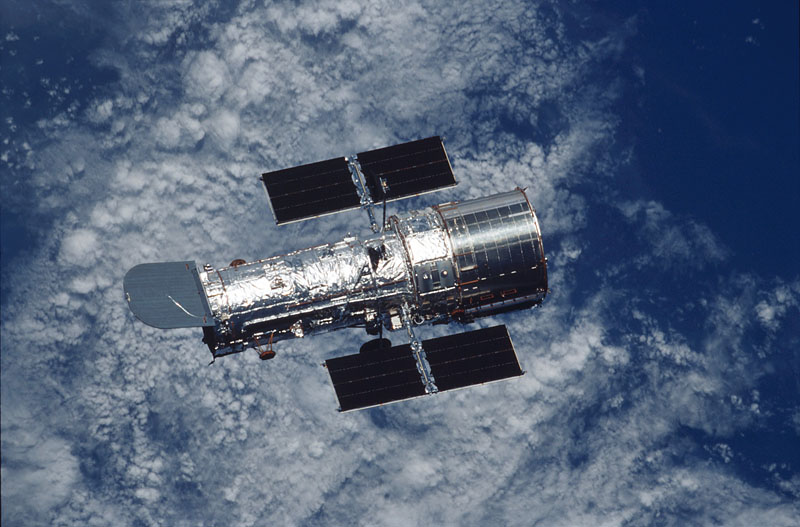
The Hubble Space Telescope.
 Image Credit:  NASA, Z. Levay
The specifics of when HST actually collects the data are hammered out by a dedicated team of STScI research support staff. These program coordinators and calendar builders have the job of piecing together the puzzle of many hundreds of different HST observations. Each observation has a unique set of constraints to consider: When is the target visible? What does the rotation of the telescope need to be? Are there bright stars near the target that HST can use to lock its position? Each week the calendar builders balance these competing requirements and put together a very detailed schedule for exactly what HST will do two weeks in the future. Efficiently packing and organizing those observations is a big task, and one with real significance. Astronomers and telescope operators know that every observation with HST is a precious resource, and represents a substantial investment in this science. The total cost of HST divided by its lifetime works out to about $15 per second, or $54,000 per hour. All the careful advance planning is really critical for maximizing the science return from that investment. 

For CANDELS, however, we can't plan out all of our observations many months in advance. One of our primary science goals is to detect and analyze distant supernovae: stars reaching the end of their life-cycle with a violent explosion. The explosion itself occurs without warning in a fraction of a second, and we can observe the after-glow for weeks and months afterward. There is no way to predict when and where these explosions may appear, but when we do spot one, we often need to quickly mobilize HST for follow-up observations, while the supernova is still bright enough to see. For this type of object, the HST operators allow a special mode for submitting observation plans, called the Target Of Opportunity (ToO) mode.

Here's how it works:

When we discover a new supernova of interest, like the record-setting SN Wilson, we sift through all the available data and decide that we want to get a quick follow-up observation, maybe as soon as next week. We quickly contact our program coordinators at STScI and tell them that we're going to trigger a ToO observation. Then we plan out the observations and submit them for review. To make room for our new ToO supernova, the calendar builders then pull out some of the pre-planned observations from other programs (they'll get put back in sometime later in the year). 

The bright star in the lower left is SN 1994D
in the galaxy NGC 4526.
Image Credit: High-z SN Search Team, HST, NASA
With experience and good organization, the detailed observing plan for a new SN can be arranged in a few hours - but sometimes we only have a few hours to spare. For most ground-based observatories, normal ToO observations can be slotted in on the same night that a supernova is discovered. For HST, however, it is much more complex and risky to make sudden changes, so each week the HST schedule gets locked in place on Wednesday morning. We need to give the program coordinators and calendar builders at least 4-5 hours to process a new observation, so that means that we have a weekly deadline of 12 noon each Tuesday for any new ToO interruptions.   

This brings us to the peculiar situation that if we happen to discover a new supernova on a Wednesday, then we have almost a week to leisurely examine the data and decide whether it warrants a ToO trigger. If that same supernova is found on a Monday, though, we are scrambling to get all our decisions made and plans in place before the Tuesday noon deadline. This can lead to some long hours on Monday nights when CANDELS observations are coming down from HST - but its exciting and rare to get any kind of astronomy in rapid action. We supernova hunters really appreciate what a unique privilege it is to get to push around an orbiting space telescope at the last minute when our science requires it. 

Wednesday, April 3, 2013

On Mountain Tops and Lasers

The Subaru Telescope (left) next to the two Keck Telescopes on Mauna Kea.
Image Credit: J. Pennington
Tonight I am sitting on top of a 14,000 foot mountain observing distant galaxies. This is the second of a three night run at the Subaru Telescope on Mauna Kea on the Big Island of Hawaii. In a previous post I talked about a run to obtain spectroscopy on one of the Keck Telescopes and some of the excitement, including ups and downs, that are part and parcel of an observing run. This run is no exception!

Initially, my collaborators from the University of Hawaii and I proposed to obtain near-infrared spectroscopy of distant luminous and ultraluminous infrared galaxies using an instrument called FMOS. Due to a problem with the telescope, that instrument turned out to be unavailable during this run so we had to scramble to change our science program to use a completely different instrument. I'm sure I'll talk more about FMOS in the future, but for now I'll focus on what we're doing this week!

The instrument we are using is called IRCS - the Infrared Camera and Spectrograph. We are only using the imaging mode of this camera. The exciting thing about this run is that we are also using the Laser guide star adaptive optics system on Subaru. Briefly, adaptive optics is a technique used by astronomers to obtain images at a higher resolution (and therefore allows us to study features at greater detail) than we normally can from the ground. Since we have to observe through the Earth's atmosphere, our images are blurrier than they would be from space. The reason for this is that the turbulence of the atmosphere causes the light from distant objects to shift in position on a very short timescale (this is why stars twinkle!). As you take an image with a camera on a telescope, this shifting adds up, causing the resulting image to be blurry. Ever notice how a picture on your digital camera is blurry if your subject moves while you are taking it?

Image of the nuclear region of a nearby galaxy (NGC 7469) taken with
and without adaptive optics at CFHT.
Image credit: Center for Adaptive Optics
We can counteract some of this by placing our telescopes on top of tall mountains (such as Mauna Kea) and therefore above some of the atmosphere. We can improve on this even more by using adaptive optics. Adaptive optics uses a bright star to correct for the effects of the atmosphere. Since we know what a star is supposed to look like (it should be point-like in images), the distortions introduced by the atmosphere can be calculated and a deformable mirror is re-shaped so that the light goes where it's supposed to. These corrections can result in images almost or just as sharp as those taken from space (check out the example to the left)! However, since the turbulence of the atmosphere is different at every point on the sky, in order to make these corrections you need to have a bright star that is very close to the object you are trying to observe. This isn't always possible and can be very difficult in our deep fields. This is where Laser Guide Star Adaptive Optics comes in!

Laser from the Subaru Telescope
Image credit: D. Birchall
Laser Guide Star Adaptive Optics is used to create an artificial star close to the object you are observing anywhere in the sky. A bright star is still needed, but it can be a little fainter and a little farther away. This technology has opened up a much larger area of the sky for this kind of imaging! As I am typing this, there is a laser from Subaru aimed at the target I am observing. Keck is also using their laser tonight. You can often see these lasers in images of the telescopes (such as the ones to the right and below).

Tonight we are targeting galaxies within COSMOS and EGS that fall outside of the CANDELS WFC3 HST coverage. In this way, we can obtain high resolution near-infrared images of select interesting targets in order to study their morphology in detail. These galaxies are all sources with extreme infrared luminosities and with this data we will be able to search for signatures of galaxy mergers and study the properties of any star-forming clumps we detect. Our first night was lost due to some problems with the dome shutter but those problems have been fixed and tonight we making our way through our list of targets! 

Using the laser always makes for a particularly busy night of observing because there are many things to consider when shining a bright laser into the sky. First of all, all of our targets must be submitted to Space Command for approval ahead of time to insure that the laser does not interfere with any passing satellites. Because of this, there are certain times of the nights where we must pause our observations or switch targets. We also have to be careful about any planes that might be passing overhead. While the laser is shining, there are always a couple of people standing outside watching, ready to turn off the laser just in case. So far, tonight is going pretty well and the forecast looks great for tomorrow as well!

Panoramic image showing lasers from Subaru and both Keck Telescopes. Image Credit: D. Birchall

Friday, March 1, 2013

The week of the HST deadline

Hubble Space Telescope, Image credit: NASA
You might have been wondering why the blog has been so quiet this week. Well, the deadline for another round of proposals using the Hubble Space Telescope (HST) is this Friday, March 1st. Many CANDELS team members are caught up in frantically writing and finishing observation proposals. An observational proposal requires a lot of work. Not only does one have to present a scientifically interesting idea, the so-called science justification, for the use of an expensive facility like the HST, the proposal writers also need to put together a technical justification. The latter includes a more detailed observation strategy that outlines number and length of the proposed observations and which available instruments will be used. Since often many astronomers build a team (just like CANDELS although usually a lot smaller) to propose for their idea, everybody is involved in putting the proposal together and constantly communicates with each other right up until the deadline to make their proposal as strong as possible. For HST several types of proposals can be submitted. The first type is the so-called archival and theoretical proposal, which is mainly a proposal for funding to support one's research. As the name indicates, astronomers base their research idea upon already existing observations in the HST archive or theoretical work that they need support for. The second type is proposing to carry out new observations with HST.

Like all telescopes, observing time with HST (and funding) is highly competitive and many more astronomers will submit proposals than there is time available (or money to spend). However, we won't know which proposals were accepted before the end of May. Once an observing proposal is accepted it has to successfully pass Phase II. This includes working with an assigned program coordinator at the Space Telescope Science Institute in Baltimore, that runs HST, to put together a plan for the observations which then can be scheduled on HST. This observational plan has to be submitted by the end of June, so only about a month after one has been notified that the proposal was accepted. However, a proposal is only fully accepted once all the technical details for the observation plan have been successfully worked out, it has been assured that the same (or very similar) observations are not carried out more than once (e.g. different proposers want to observe the same piece of sky in the same filter bands and depths or an observation exists already in the archive) and it has been checked that all observational requirements are technically possible and feasible for HST. When all these hoops have been jumped through, HST can take the data and astronomers can analyze and interpret it and then publish their results.

Friday, December 21, 2012

Life as an Observer

The Keck Telescopes on Mauna Kea
Courtesy W. M. Keck Observatory
One of the best aspects of being an astronomer is actually using a telescope and collecting data. Tonight, I have the opportunity to use one of the best telescopes in the world along with an exciting new instrument. Fellow CANDELS team member Mark Dickinson and I are observing on one of the Keck telescopes atop Mauna Kea on the Big Island of Hawaii. Mauna Kea is one of the best observing sites on the planet because the peak of the mountain where the telescopes are located sits above a substantial portion of the atmosphere. Because of this, the atmosphere has less of an effect on the images of astronomical objects than it would from an observatory at sea level. While the Keck telescopes themselves are at the summit of the 14,000 foot mountain, observers work from a remote observing facility located in Waimea. Being at this lower altitude makes it much easier to work and all of the instruments can be controlled remotely. 

The instrument that we are using is called MOSFIRE (Multi-Object Spectrometer for InfraRed Exploration) and is very new. It is a top of the line instrument that allows us to obtain sensitive, high resolution near-infrared spectroscopy of many objects at the same time. Most spectrographs in the near-infrared observe one object at a time. There are now several available that can observe many objects at once but they are often difficult to use for very faint galaxies. MOSFIRE is still brand new but so far has been working well. CANDELS team member Jonathan Trump recently published a paper on some first results! 

Mark Dickinson and I observing in the Keck I Remote Observing
Control Room
We spent the last several days carefully selecting targets to observe in two of the CANDELS fields, GOODS-S and COSMOS. Our primary targets of interest are distant luminous infrared galaxies detected by the Herschel Space Observatory at z~2. At this redshift, many of the interesting optical emission lines (such as the Hydrogen line known as H-alpha) are shifted into the near infrared. We can use these various lines to measure precisely how far away the galaxies are, whether or not an AGN might be present, how important that AGN is to the energy output of the galaxy, how much star formation is taking place in the galaxy, as well as many other things.

In addition to these targets, we are also observing AGN selected in other ways, such as through X-ray detections or from the shape of their SED in the near-infrared. If there is any space left we are also looking at other types of galaxies at these high redshifts to see if we can detect lines

Once our target selection was complete, we waited anxiously to see what the weather would do. The forecast called for clear skies but starting last night the summit of Mauna Kea became foggy. We awoke this morning (morning for an observing astronomer is really about 2 PM) to find that the fog had not cleared and some clouds had rolled in. We were really starting to get nervous! However, we proceeded as planned and began our afternoon setup. Around sunset, things were really looking dicey and it started to snow! Luckily for us that didn't last too long and the road to the summit remained clear for the night crew to head up and check things out. After a couple of hours, the fog cleared and the humidity dropped to a level low enough to open. We had a good time learning how to operate this new instrument and at 9:30 PM we started our first exposure on a set of galaxies in GOODS-S!

 
Video from a webcam at CFHT (the Canada-France-Hawaii Telescope) on Mauna Kea showing the clouds roll in Wednesday night and ice starting to form on the camera itself. Video courtesy of CFHT Observatory


Over the course of the night clouds have come and gone but the weather has steadily been improving. Right now we are observing galaxies in COSMOS and things are looking good. We are anxious to analyze our data and see how many of our galaxies have been detected. With any luck, we will soon be writing a blog post about our results! 

This is our last blog post before the holidays but we look forward to discussing more CANDELS science in January. Happy Holidays! 

Follow the Keck Observatory on Twitter!  

Friday, November 9, 2012

What's it like to work at NASA? (Quick answer: Awesome!)

My name is Amber Straughn, and I'm an astrophysicist at NASA's Goddard Space Flight Center in Greenbelt, MD, about 15 miles outside of Washington DC. I study the morphologies and star forming properties of intermediate redshift (z~2) galaxies using both imaging and grism spectroscopic data from Hubble. I've been here at Goddard for a little over four years now -- but let me start from the beginning of my story.

I grew up in a small farming town in rural Arkansas -- the exact type of place you think of when you think of dark night skies. Like many astronomers, it's exactly this that got me started on my path towards astronomy. My hometown, Bee Branch, is still just as dark today as it was when I was a kid, and I always enjoy going back home and reacquainting myself with the skies that drew me in years ago. I'm one of those astronomers that knew from a very early age that I wanted to study the universe -- I was very interested in elementary school and had decided for sure in Jr. High that astronomy was the path I wanted to pursue. After high school, I left my tiny town for the slightly larger town of Fayetteville, AR, where I got my B.S. in Physics and did my honors research project on eclipsing binary stars using the small telescope at the University of Arkansas. I also did a summer REU at MIT Haystack Observatory, where I got my feet wet in radio astronomy, studying SiO masers using VLBI data.  After undergrad, I went on to Arizona State University, where I got my M.S. and Ph.D. in Physics, all the while doing research in astronomy. It was in grad school where I first got to work with Hubble data and really focus in on my main interest area: the distant universe.

While my academic path after high school was somewhat typical, it seems that NASA has always been in my pathway. Of course, I grew up watching the shuttle launches, and was an instant fan of Hubble after it launched. My first "official" interaction with NASA was as an undergrad, when I was part of a 4-person team that designed and flew an experiment on NASA's KC-135 zero-gravity plane, aka "the vomit comet" (I didn't vomit!). Needless to say, being weightless was an unforgettable experience - -to this day, one of the most fun things I've ever done - -and I was hooked on NASA from that point on. I was an Arizona NASA Space Grant fellow for a couple of summers during grad school, and during my third year at ASU received the NASA Harriett Jenkins Predoctoral Fellowship for women and minorities in STEM, which funded me for the remaining three years of my grad studies. The Jenkins Fellowship funded me to go to a NASA center during the summers for research, and so I came to Goddard. After grad school, I got a NASA Postdoctoral Program Fellowship at Goddard, and after 2.5 years as a postdoc, was hired for a permanent position at Goddard.

Working at NASA is in many ways similar to any other academic position in astronomy in that you do research in collaborations and teams, you write grant proposals and telescope proposals, you present your research at meetings and workshops, and you mentor students.  You do community work like referee papers and sit on committees, etc., and you do public outreach. The key thing that makes NASA different from a university is of course the lack of teaching duties in a classroom (although some NASA folk are also adjunct faculty at nearby universities…and we collaborate extensively with local universities). Here at NASA, we have "mission duties" or other similar work that carries on NASA's mission.  Which means (and this is why it's awesome!) -- I get to work on THIS:

JWST Mirrors
…which is of course the James Webb Space Telescope, the 100x-more-powerful successor to Hubble that will be launched in 2018. Specifically, I'm on the Project Science team; I'm the Deputy Project Scientist for Communications/Outreach. Part of my official duties for JWST -- in addition to thinking about the science that we'll do with the observatory in the future -- is to ensure the scientific accuracy of our public-facing content (press releases, web pages, social media, etc.) and help get the message of JWST out to the world.  And by "to the world", I mean to the public, the media, and legislators (i.e. Congress).


A single JWST mirror segment being inspected (left) and the subshield (right)


One of the fantastic things about working at NASA is the people I get to work with on a day to day basis. There are plenty of brilliant people that work here; in any given week I routinely have conversations with Nobel laureates (specifically the Senior Project Scientist for JWST, Dr. John Mather) and astronauts. Here at Goddard, I can walk downstairs and see world-class detector labs with cutting edge technology being developed, or take a stroll across the parking lot to the world's largest Class 10,000 cleanroom (which has a live webcam, by the way, so everyone can have a peek at what's going on) where JWST is being assembled. There are all kinds of crazy cool test facilities here at Goddard, including a huge centrifuge, thermal vacuum chamber, and acoustics testing facility where spacecraft make their way through before being launched. Since I'm an astrophysicist, before I came to Goddard my focus was of course on astrophysics missions -- but being here has given me a new appreciation for the huge array of science missions that NASA launches in addition to astrophysics: missions in earth science, heliophysics, and planetary science. Goddard is such a cool place that it also attracts a fair share of celebrity types. In the last couple of years we've had Seth Green, Bill Nye, and Kal Penn come through for VIP tours of Goddard, to name a few. One of my most fun days at Goddard so far was filming a spoof music video about Hubble and JWST with a crew from Late Night with Jimmy Fallon for his "Hubble Gotchu" segment, which turned out hilarious -- so much fun!

In some ways, my job at NASA is easy because this project is easy to get excited about: JWST will be the largest telescope ever launched into space, and will answer huge astronomy questions -- questions about the origins of galaxies, of stellar systems, and of planets capable of supporting life. I'm absolutely convinced that this telescope will reveal mysteries of the universe that we haven't even thought to wonder about yet. And this is why it's so incredible to work at NASA, to be able to help a tiny bit in furthering humanity's search for answers about our incredible universe.

Wednesday, October 24, 2012

What is an Observing Proposal?

Have you ever wondered what astronomers have to do to get to go on observing runs to telescopes? You might think that there are a lot of telescopes and thus astronomers can go observing whenever they want to or you might think that they observe every night. Actually, time on telescopes is in very high demand and astronomers have to compete with each other for every night of telescope time they get. In order to enter this process, astronomers must write a document called an observing proposal. This is the typical process for almost all telescopes, including big and small facilities, facilities run by a single University, those run by groups of Universities, and national facilities. Space-based telescopes (like Hubble!) also follow this procedure.

Image of Kitt Peak National Observatory, managed by NOAO. Image credit: Michael L. Weasner
In order to apply for telescope time, the first step is to come up with a good idea. Astronomers often have multiple projects going on at once and we are always thinking of new ideas and questions and ways to improve upon what we know. Once we have an idea we have to decide what telescope (and instrument) would be the most suited to accomplishing the science goals we have in mind. The instrument needed can often be more important than the telescope itself. Is the goal imaging or spectroscopy? Is there a particular wavelength range or filter needed? Do we need to target a single object or small patch of sky or are we surveying a large area? All of these factors go into selecting the best telescope-instrument pair. This selection can also depend on the University or country that the astronomer is at. Different Universities have access to different Observatories depending on funding, instrument development, and various other partnerships. There are also various facilities run on a national level -- for example NOAO in the US or ESO in Europe.

The next step is the bulk of the work: writing the actual proposal. A typical observing proposal has several components. The main one is called the Scientific Justification -- basically, describe why the science project you want to do is interesting. This is the place where an astronomer has to really sell their idea and convince others that answering this particular question is very important and must be done. Often, those reviewing proposals do not work in the particular specialty of the proposer so a good proposal is one that can be understood by any astronomer, not just experts on that particular topic. We must also clearly lay out the strategy of the science project here: how will the observations that we are proposing for answer this important question? What kind of data will be taken and how will this data be used to solve the problem presented? Often astronomers are limited to only a couple of pages of text so it can take a lot of work to say everything you want to say succinctly.

Another typical component of an observing proposal is a technical section. This is where an astronomer must go into detail about the instrument and telescope they are proposing to use and say why this particular combination is well suited. They must clearly demonstrate how much data they need and how much time this will take overall. Since observing time is a precious commodity, any time request must be clearly justified - if you say you will need two nights to accomplish your goals then you must show that two nights are really needed and one night would not be enough. Often, this portion is reviewed by people who are experts with the given instrument and who understand how well the instrument will perform.

It is important that a proposal be very well written! In fact, the ability to write well is a very important job skill for astronomers in general. An astronomer must be clear and concise in their proposal. If there is confusion about the goals or how they are going to address a particular problem, this could negatively impact the proposal's chance of success. It is also very useful to include informative graphics that illustrate the science goals and method presented. As they say, a picture is worth a thousand words, and a clear well-thought out figure can really strengthen a proposal. Finally, this might seem obvious but it is very important that all of the rules be followed! A proposal cannot be longer than the given limit and cannot be written in too small of a font or with tiny margins. This might seem picky, but when a person has to review a lot of proposals they all need to be easy to read. At last, the proposal is complete and can be submitted (and must be on time!). At this stage, the astronomer can sit back, relax, and start thinking about their next big idea.

But the process has only just started on the receiving end. Most observing proposals are then evaluated by a committee of peers (other astronomers, either from the specific institute that runs that particular telescope, or selected from all over). Every proposal is read by the entire committee and the committee gets together to discuss each one over the course of a few days. It's not always easy to pick out the best proposals to award time to. Often there are more excellent proposals than there are nights to be awarded. Intense discussions about the merits of each proposal results in a ranked list and time is given to those proposals at the very top. Every one that does not get their proposal accepted must try again next time.

This may sound like a lot of work, and it is, but whenever a proposal is accepted and we get the opportunity to observe and collect new data, it is all worth it. It is a great feeling to know that your peers have found your ideas worthy of supporting! This is a process that we go through once or twice a year for each telescope we would like to collect data with. One of the major observing seasons of the year just finished this past September. Luckily there is a little bit of a break before the next major deadline in February (for HST). This break is needed so that we can work on analyzing all of the data from the previous year!

Monday, July 23, 2012

A Week at the LBT

One of the most rewarding aspects of a career in astronomy is the chance to go observing at a professional observatory. I recently spent a week at the Large Binocular Telescope (LBT) in Arizona, observing for the Max Planck Institute. With me were two other observers, Hugh and Mario, members of other research teams at the Institute. In total, we had 6 full nights with which to pursue our various science programs, as well as collect astronomical data for other scientists in our research consortium.

The LBT is a marvel of engineering. It consists of two enormous primary mirrors, each 8 meters (26 ft) in diameter, mounted on the same huge superstructure, a squat but airy truss of red-painted steel, carbon fibre, cabling and glass. The mirrors are built to look up at the same region of sky and the LBT can track an object through its pair of binocular 'eyes' with incredible sub-arcsecond accuracy. The two telescopes will eventually be combined into an Interferometer - an advanced technology instrument that behaves a bit like a single telescope 12 meters in size.

Standing below one of the LBT mirrors.
Click for an album of images from my trip
.
A large telescope such as the LBT is used at the forefront of astronomical research. Take for example the kinds of science that we were pursuing for those 6 nights. I was using an instrument called LUCI that is sensitive to light in the near-infrared. With LUCI, I obtained spectra of galaxies that are tens of billions of light years away, when stars were forming throughout the Universe at a furious pace. Hugh was using LUCI to precisely measure the apparent sizes of nearby stars, allowing him to look for the presence of disks of dust around them, solar systems in their youth. Intense star-forming regions in our Milky Way galaxy interested Mario: he wanted to train LUCI on some of their most massive stars.

The 2 hour drive from Tucson went up a windy mountain road rising from the desert to the pine and fir crested peak that hosts the Mount Graham International Observatory. In a large trolley, we carried up a week's worth our of groceries up to the Observer's dining area, which sported large windows overlooking the Pinaleño mountains, a row of big refrigerators, a full kitchen, comfy couches and - joy! - a pool table. This, and the attached sleeping cubicles, were to be our home for the duration of our run. We chatted with the last shift of observers, talked about science and telescope issues, settled into our rooms and got accustomed to the thin air at 11,000 ft.

The next day we started our run. Things didn't go according to plan.

In the heady days of tall ships, being caught in the Equatorial becalming zones called the Doldrums came to be a bane of sailors. The word was adopted into modern English to mean times of ennui and lack of activity. Bizarrely, at the LBT, the Doldrums happen when the wind is high, because the telescope dome cannot be opened if it's blowing so hard that the telescope structure could suffer serious stress. We waited and watched unsuccessfully for the telescope to open while howling gale-force winds buffeted the top of Mount Graham. An unusual weather system, which started before we arrived at the peak, kept up a steady barrage of dusty winds for four whole days and nights (taking a night away from the observers before us). As a result, we never actually looked at sky for half of our run, though, if one had stood on the balcony of the telescope dome and look up without being blown off, one would have seen a lovely Milky Way over the horizon and bright stars burning against a velvet black sky. This was a painful reminder of one of the misfortunes of astronomical observing - Weather. Observatories are built in far off and inaccessible places for a reason: those very places, usually deserts or high mountain tops, have the best observing conditions. Time on a big telescope comes at a premium, both monetary and in man hours, so they are designed for a maximum return.

In contrast, the next three nights were fantastic! As the winds died away, the front of calm weather beyond brought superb, twinkle-less skies (heavy twinkling is a sign of turbulent air, something we call "bad seeing") and a thin young moon. With the help of our fantastic Support Astronomer, Olga, who helped deal with a niggle that kept putting the telescope an arcsecond away from where it should have been, I managed to get 7 hours of great data with which we mapped the movement of star-forming regions in twelve galaxies at a redshift of 1.5, seeing them as they were in a 5 billion year old Universe. Hugh, with a twinkle in his eye, showed us the subtle blooming of his stellar spectra that revealed a thin disk of young planetesimals in a star light years away. Mario fussed about excitedly with his spectra, judging quality and applying numerous calibrations. Things proceeded without a hitch and we even had time, while the telescope was kept busy running automated scripts on a long exposure, to play the odd game of pool in the observer's dining room.


For a century, since the rise of large institutional observatories, astronomers have packed their cases - once full of photographic plates, chemicals, and cold weather gear; now with laptops, manuals, and comfortable shoes - and climbed mountains to expand our view of the Universe. Observatories, whether on the ground or up in space, continue to enrich our knowledge and serve as test-beds for cutting edge technology, and we hope that we, as astronomers and as humans, will always be able to find that lone narrow and windy road that takes us up to the stars.

Friday, July 20, 2012

ALMA Opens its Eyes to the Sky

High in the Atacama Desert of northern Chile a new astronomical instrument is under construction. It is the Atacama Large Millimeter/Submillimeter (mm/submm) Array, aka ALMA. With its large number of antennas, its location in one of the driest places on the Earth, and at an altitude of 5000m (16,500 feet), ALMA represents a huge step forward for millimeter/submm astronomy, with promises of fantastic science to come. But why build such an expensive observatory (ALMA is the most expensive ground based instrument ever built) at such an inhospitable place (high altitude and extremely dry), and, how is it important for CANDELS?

ALMA antennas at the Chajnantor Plateau. Photo credit: Babak Tafreshi

First a few definitions: astronomers use the term 'radio' when dealing with electromagnetic radiation with wavelengths from hundreds of meters to less than a millimeter (submm). It has nothing to do with actually listening, like we listen to a normal radio, but with detecting this electromagnetic radiation using sensitive receivers. In this blog I will use the terms 'radio', 'mm' and 'submm' to refer to this type of emission - and the instruments used to detect it. Wavelengths are given in millimeters (mm), sometimes referred to as 'submm' when it's slightly less than 1mm, and in microns (a millionth of a meter).

If you could view the sky with eyes that were sensitive to millimeter and submillimeter wavelengths, it would look very different from what we see with the eyes we have. Instead of warm and hot celestial objects, such as stars and ionized gases, you would see dark and cold interstellar clouds, dusty disks around young stars, faint cirrus clouds permeating our Galaxy, and the occasional point-like quasar. The interstellar dust grains are heated by stellar light that is re-radiated at far-infrared and submm wavelengths. The characteristic dust temperature is in the range 20-40K and the molecular gas that permeates interstellar space can be even colder than that. Your ‘submm eyes’ would pick up the light from thousands of spectral lines, mainly coming from rotational transitions of simple – and some not quite so simple – molecules. Most of the light would be diffuse and spread out over the sky, but a few point-like sources would also be seen. These are synchrotron radiating Active Galactic Nuclei (AGNs) - the main part of the emission is, however, thermal in character.

As a matter of fact, your eyes wouldn’t actually see much of anything, even if they were sensitive to these wavelengths. The reason for this is two-fold; First, there isn’t as much energy in the mm/submm light as there is at optical wavelengths. A photon with a wavelength of 1mm has about 2,200 times less energy than one at 0.45 microns (visible light). Second, the angular resolution provided by the eye would be very limited indeed. The small diameter of the eye’s pupil would make the sky look blurry, providing an angular resolution roughly 1,000 times worse than what they do at optical wavelengths. You would have a hard time to pick out even the Moon or the Sun.

These degrading effects associated with observing the universe at longer wavelengths translate to more conventional telescopes as well; a radio telescope has to be bigger, in fact a lot bigger, than an optical telescope in order to achieve a similar performance. From an engineering point of view it is easier to build a large radio telescope than to build a corresponding optical telescope, but gravity and money limit how big they can really be. To circumvent these limitations, radio astronomers have long used the technique of interferometry, where the light from several telescopes is combined to improve angular resolution, and, in most cases, improve sensitivity. The use of several radio telescopes, or 'antennas', as an interferometer is referred to as aperture synthesis. Rather than go into details here, I recommend wikipedia's general overview of astronomical interferometers.

In fact, the first radio interferometer observations were done back in 1946, using a single antenna that happened to look out over the ocean. With this setup, the rising sun reflecting off the ocean surface creates interference fringes with the light directly reaching the receiver. The results showed that solar radiation at radio wavelengths during a flare is co-located with the corresponding sunspot and active area. These sea-cliff interferometers could create baselines up to ~200m.

As an aside, interference from single antennas looking towards the horizon were first identified during WWII when trying to detect approaching aircraft along the British coast and was correctly interpreted as an ‘interferometric’ effect.

ALMA antennas being tested at the Operations Support Facility. Photo: T. Wiklind


The latest radio interferometer is currently being built high in the Chilean Andes, quiet far from any ocean. This is of course the Atacama Large Millimeter/submillimeter Array, or ALMA; a project with a history going back more than 25 years. ALMA is a collaborative effort of three partners: North America, Europe, and East Asia. ALMA represents a huge step forward in terms of both sensitivity and angular resolution at mm and submm wavelengths, being about 10-1000 times more sensitive than existing instruments (depending on the wavelength). When completed, ALMA will consist of 66 high precision antennas located on the Chajnantor Plateau at an altitude of 5000m (16,500 feet). The antennas are divided into a main array, made up of fifty 12m telescopes, and the ALMA Compact Array (ACA) with twelve 7m and four 12m antennas. The total telescope area will correspond to a single dish with a diameter of 91m.

ALMA Operations Support Facility. Photo: T. Wiklind
ALMA produces both images and spectroscopic data with a wavelength coverage currently ranging from 3mm to 430 microns. When all planned receivers are installed, the wavelength coverage will range from 10mm to 320 microns. The antennas will be spread out over the Chajnantor Plateau with the longest baselines reaching 15km. This will allow an angular resolution of 5 milli-arcseconds for the most extended configuration and the shortest wavelength. This resolution would make it possible for ALMA to view NASA's left-over Lunar Rovers on the Moon (at least in principle – the Rovers don't radiate well at mm/submm wavelengths).

The Salar de Atacama, looking up towards the Chajnantor plateau.
Although the construction of ALMA will not be over until late 2013, scientific observations have already started. The deadline for the second call for Early Science Proposals was July 12, 2012 and resulted in more than 1,000 proposals. During the Early Science phase, ALMA will operate with fewer antennas than it will have when completed, but it already represents the best sensitivity and the highest angular resolution available at these wavelengths – which explains the intense interest among astronomers in using ALMA. Cycle 1 observations (ALMA science started with Cycle 0 in 2011) will be done with a minimum of 32 12m antennas, allow the use of a limited ALMA Compact Array (ACA), but do not include all the receiver bands that will eventually be installed. The introduction of the ACA in this cycle represents a big step forward. ALMA is extraordinarily sensitive and has an enormous angular resolution, but the penalty is that it loses sensitivity to structures more extended than a few arceconds (again, wavelength dependent). The reason is that the 12m antennas cannot be placed close together, lest they start shadowing each other. This means that the ‘inner’ part of the synthesized telescope is missing. By using the compact array, with the smaller 7m antennas, it is possible to fill the hole and allow ALMA to image large- as well as small-scale structure.
Sunset at the Operations Support Facility. Photo: T. Wiklind

So what can ALMA do for CANDELS aficionados? The science specification for ALMA states that it shall be able to detect a galaxy like the Milky Way at a redshift z=3 in the lines of carbon monoxide (CO is the second most common molecule in the Universe – the most common is molecular hydrogen but it does not radiate effectively since it is close to perfectly symmetric) or [CII] (singly ionized carbon atom) in less than 24 hours – remember that ALMA was conceived at a time when very little was known about the high redshift universe. The full ALMA will certainly be able to do this, but only with a few hours to spare. Fortunately, galaxies at high redshift are now believed to be considerably more gas-rich than their present day counterparts making them even easier to detect at these wavelengths, and it will in fact be possible to observe a lot more than a single galaxy per day.

An example of a high-redshift observation, done as part of the ALMA Science Verification program, is the far-infrared luminous quasar BR1202-0725. This quasar has a redshift z=4.7, meaning that the photons we observe from this object were emitted 12.4 billion years ago, just 1.3 billion years after the Big Bang. BR1202-0725 was observed with seventeen 12m antennas for a total on-source time of 25 minutes. The receivers were tuned to the atomic fine-structure line [CII] with a rest-frame wavelength of 158 microns, here redshifted to 900 microns. Two sources are detected in the [CII] line, the quasar and a nearby galaxy just 3.8” to the NW of the quasar. A third component 2.5” to the SW is seen in the continuum emission. The third component is not seen in the [CII] line and was previously unknown. It is presently not clear that the SW source is associated with the two other sources – but the proximity suggests it is. We will know as soon as we get additional data on this new object.
BR1202-0725, Top: ALMA continuum (green contours) and HST images in 3 different bands. The bright source seen in the HST images is the quasar. The submm sources seen to the NW and SW of the quasar have weak optical emission associated with them. Bottom: Spectra of the [CII] line from the quasar and the NW source. Notice that the NW source has a very broad line profile. From Wagg et al. 2012, ApJ 752, L30.
While ALMA provides unprecedented sensitivity for line observations, it really excels when it comes to continuum emission. The state-of-the-art receivers, broad bandwidth, and the high-and-dry location all conspire to provide a high sensitivity. On top of that, the Universe is very kind to submm observers; at a fixed observed wavelength, the distance dimming is offset by the increase in restframe flux. This leads to a sensitivity that is almost independent of distance in the redshift range z=1–10 (a redshift z=10 corresponds to a time only 480 million years after the Big Bang). This statement is true when observing at a relatively long wavelength (850 microns) and for dust grains characterized by a temperature 40K or lower. Already in Cycle 1 (the second call for proposals), it is possible to detect far-infrared luminosities of about 1011 Lo (that is 100 billion times the Sun's luminosity, a rather modest luminosity for star forming galaxies) at redshifts up to z~10 in less than 10 minutes of integration time.

The observed flux at two fixed wavelengths (850 and 450 microns) as a function of redshift. The total far-infrared luminosity is set to 1012 Lo and the flux is shown for several different dust temperatures. Figure ripped from one of my powerpoint presentations.


One thing that ALMA is not, however, is a survey instrument. The field of view (FoV) is given by the field of view of an individual antenna. For a 12m antenna, the FoV - aka as the ‘primary beam’ – ranges from ~62” at a wavelength of 3mm (100GHz) to 8.5” at 420 microns (720GHz), that corresponds to 0.8 – 0.016 square arcminutes, respectively. As a comparison, seen from the Earth, the Moon covers more than 2800 square arcmintes). ALMA therefore needs targets to point at and this is where the CANDELS fields become an invaluable source for ALMA targets. The GOODS-S, UDS, and COSMOS fields can be observed with ALMA, while the EGS and GOODS-N is outside the reach of ALMA.

To summarize, ALMA is already an existing scientific facility, providing the highest sensitivity and angular resolution at millimeter and submm wavelengths. The sensitivity is such that sub-L* galaxies (fainter than the most common galaxies) can be detected with a modest investment of telescope time. ALMA produces a data set that contains both spatial and spectral information. That is, is gives information on the velocity of the emission as well as an image of its distribution. ALMA has a very limited field of view and therefore needs targets to point at. This is where the synergy between ALMA and projects like CANDELS shine.